
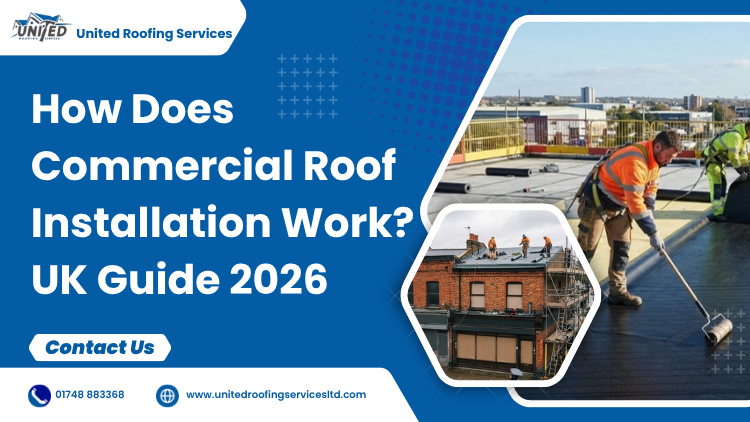
Commercial roof installation means fitting a complete, compliant roof system on a building used for business. Whether you need a brand-new roof or a commercial roof replacement, the right approach depends on your roof’s condition, your building’s age, and how much disruption your business can take.
Getting it right matters more than most owners expect. Mistakes in a new roof rarely show on handover day. They show up two or three winters later, as stained ceilings and pooling water.
This comprehensive guide covers the following questions that every commercial roofing project in London raises, whether you own the building or rent it:
- How does a new commercial roof actually get installed?
- How long will it take, and what will it cost?
- Which rules apply, and does anyone need to give permission?
- Who pays if you are a tenant?
- Can you keep trading while the work goes on?
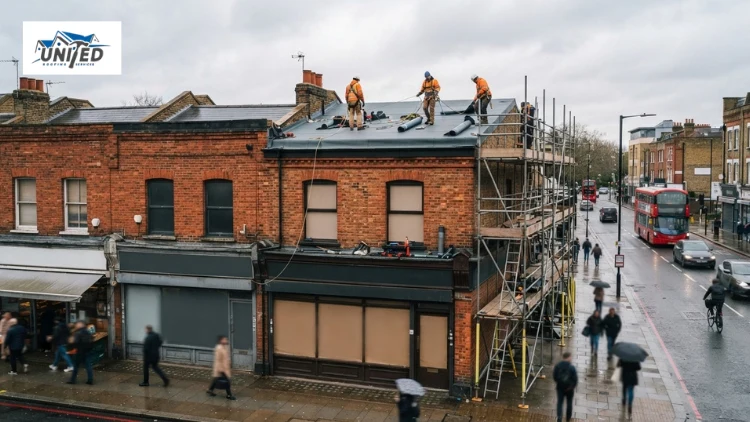
What Is Commercial Roof Installation?
Commercial roof installation means designing, supplying and fitting a complete roof system on a building used for business. Think shops, offices, restaurants, workshops, small warehouses and mixed-use blocks with flats above.
It covers far more than the waterproof layer you can see. A proper job includes the insulation underneath, the drainage that carries water away, the edge trims and flashings that keep wind out, and the paperwork you need afterwards. Get one wrong, and the whole roof suffers.
Which Roof System Suits a Small Commercial Building?
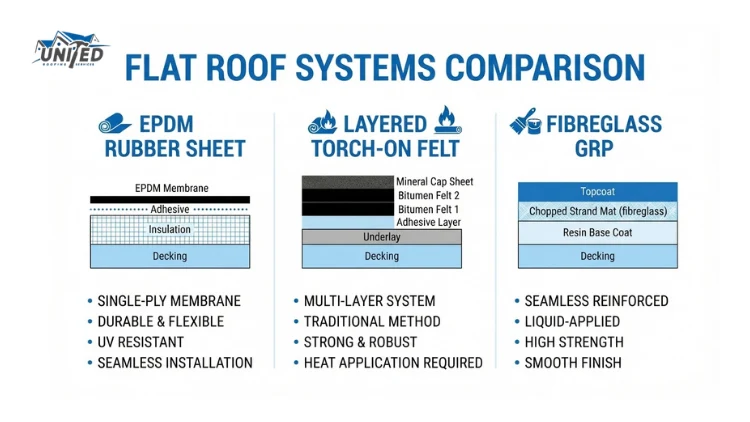
Many small commercial roofs are flat or low-pitched, and three systems cover most of them. For a broader look, including pitched roofs, read our article on roofing materials.
EPDM Rubber
EPDM is a synthetic rubber membrane supplied in large sheets. Fewer joins mean fewer places for water to get in, and it flexes with temperature changes instead of cracking. It suits most flat roofs on shops, offices and workshops. It belongs to the single-ply family, alongside PVC and TPO.
Felt
Torch-on felt is bitumen felt laid in two or three layers. It costs the least upfront and handles awkward shapes and lots of roof details well. The trade-off is a shorter life and joints that depend heavily on the fitter’s skill.
GRP Fibreglass
GRP is glass-reinforced plastic, laid as a liquid resin over the deck. It cures into one seamless surface with no joins, which suits smaller roofs with plenty of corners. It needs dry, mild weather to cure, and repairs can be harder to blend in neatly.
How Long Does a Commercial Roof Last Before It Needs Replacing?
Lifespan depends on the system, the quality of the installation and how well the roof is looked after. As a rough guide:
| System | Typical lifespan | Upkeep needed |
|---|---|---|
| Felt | 10 to 15 years | Regular checks |
| EPDM | 20 to 50 years | Low |
| GRP | 25 to 30 years | Low, but avoid impact damage |
Treat these as typical ranges, not promises. Our article on how long a roof lasts goes into more detail.
How Does Commercial Roof Installation Work?
A well-run job follows six stages, no matter the roof size.
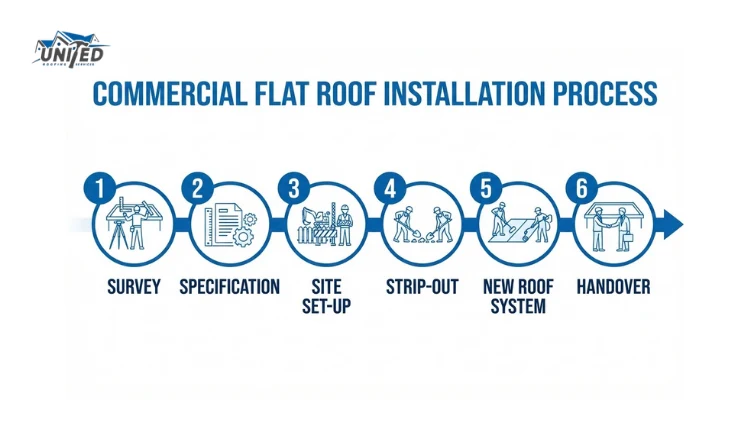
1. Survey and Moisture Check
The contractor measures the roof and inspects the surface, outlets, edges and anything that pokes through it, such as vents and pipes. On an existing roof, they also check for trapped water, using a moisture meter or a small core sample. This stage prevents most of the expensive surprises.
2. Specification and Written Quote
The survey becomes a written specification: which system, how thick the insulation is, how water will drain, and what happens to the old roof. Everything else on the job follows this document.
3. Site Set-Up and Access
Before any material goes up, the crew sets up scaffolding or edge protection, safe routes for materials, skips for waste and protection for entrances. We also agree on working hours with you at this point.
4. Strip-Out and Deck Repair
The old covering comes off in sections, so the building is never left fully open to rain. We check the deck underneath as it is uncovered, and replace any rotten or damaged boards. Fitting a new system over a weak deck wastes money.
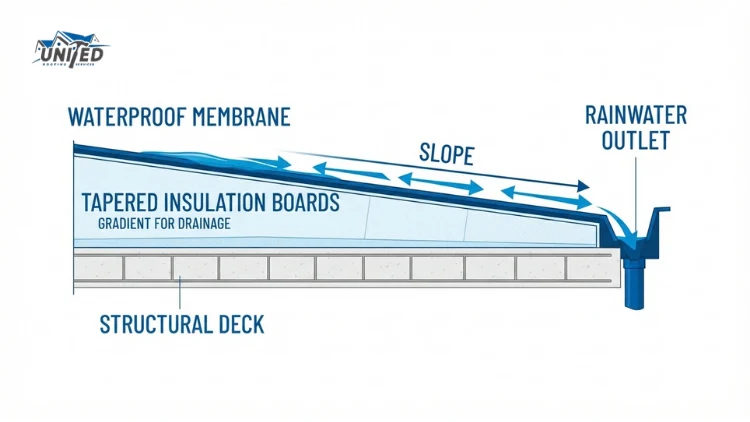
5. Insulation, Waterproofing and Drainage
Insulation goes down first. Then comes the waterproof layer, followed by the trims, flashings and outlets.
A flat roof should not be truly flat. It needs a gentle slope, called a fall, so water runs to the outlets instead of pooling. Contractors often build this in with tapered insulation, which is insulation cut to a slope. The flat roof standard BS 6229 sets out good practice for this kind of design. Good insulation also lowers heating bills, and our article on making your roof more energy efficient shows how much difference it can make.
6. Final Inspection and Handover
The contractor checks seams, edges and outlets, clears the site and hands over a record of what was installed. You should also receive guarantee documents and, where needed, Building Control sign-off.
How Long Does Commercial Roof Installation Take?
For a small commercial roof, such as a shop or small office, expect anything from a few days to two or three weeks. Bigger roofs of several hundred square metres take longer, and phased work stretches the programme further.
Four things move the timeline most:
- Roof size
- How easy the access is
- What the strip-out uncovers
- The system chosen, since GRP needs curing time between coats
How Much Does Commercial Roof Installation Cost?
There is no single price, but there are useful benchmarks. Recent UK price guides put flat roof coverings at roughly £40 to £150 per square metre. Felt sits at the lower end, GRP at the higher end, and EPDM in between. London prices tend to sit towards the top of those ranges.
What Pushes the Price Up?
- Stripping out and disposing of the old roof
- Upgrading insulation to current standards
- Repairs to a damaged deck
- Scaffolding and difficult access
- Awkward details, such as many pipes, rooflights or parapet walls
A Simple Example
Take a 100 square metre flat roof over a small shop. The covering alone could land between £4,000 and £15,000, depending on the system. Add strip-out, insulation, scaffolding and any deck repairs, and the total climbs from there. That is why an itemised quote tells you far more than a headline price per square metre.
These figures are a guide only. Treat them as a starting point, not a quote.
What Rules Apply to a Commercial Roof in London?
Commercial roofs come with more paperwork than a home re-roof. None of it is complicated once you know what to look for.
Building Regulations and Insulation
New roofs on business buildings usually fall under the Building Regulations. The energy rules sit in Approved Document L Volume 2, which covers buildings other than homes. Broadly, if more than half of a roof is being renovated, the whole roof may need to meet current insulation standards. Building Control decides, so ask them before work starts and keep the sign-off certificate.
Health and Safety Duties for You as the Client
If roof work is part of running your business, you count as a commercial client under CDM 2015. That means you must make sensible arrangements to manage the project safely, whatever its size. You must also report larger jobs to the Health and Safety Executive. That means work lasting more than 30 working days with over 20 workers on site at once, or work exceeding 500 person-days. Most small roofs stay under those limits, but your duties still apply. The Health and Safety Executive explains commercial client duties in plain terms.
Your contractor must also protect anyone working near roof edges under the Work at Height Regulations 2005. That is why you will see edge protection or scaffolding on site.
Asbestos in Older Buildings
If your building was built before 2000, the roof may contain asbestos in materials such as cement sheets or insulation boards. Under the Control of Asbestos Regulations 2012, the person responsible for a non-domestic building must manage any asbestos in it. A refurbishment survey should be done before work that disturbs the building fabric. The HSE guidance on asbestos surveys explains which type applies. Tell your contractor early, because it can change both the programme and the budget.
Conservation Areas and Listed Buildings
Whether you need planning permission depends on what changes. Swapping a roof covering for something similar in look is treated differently from changing the roof’s height, shape or appearance, and business premises are handled more strictly than homes. Conservation areas add tighter controls, and listed buildings need separate listed building consent.
Richmond upon Thames has many conservation areas, and neighbouring boroughs do too. Check with your local council before ordering materials.
Who Pays for a New Roof: The Landlord or the Tenant?
Many small businesses rent, which raises a fair question before you call a roofer. The answer sits in your lease, not in a general rule. As a starting point:
- In a building with several tenants, the landlord often arranges roof work and recovers the cost through the service charge.
- Where a tenant has taken on full repairing duties, more of the cost may fall on the tenant.
- Either way, get the landlord’s written consent before work starts, because the roof is part of the structure.
Read the repair and service charge clauses carefully, and speak to a solicitor if the wording is unclear. This article is general information, not legal advice.
Also agree who signs the contract with the roofer and who keeps the guarantee documents. Then nobody has to chase them years later.
How Do You Plan a Commercial Roofing Project?
Good planning separates a smooth job from a stressful one. Start with three decisions: who signs off the work, what budget you have (including a cushion for surprises), and when your business can best cope with disruption.
How Do You Keep a Business Open During a Commercial Roofing Project?
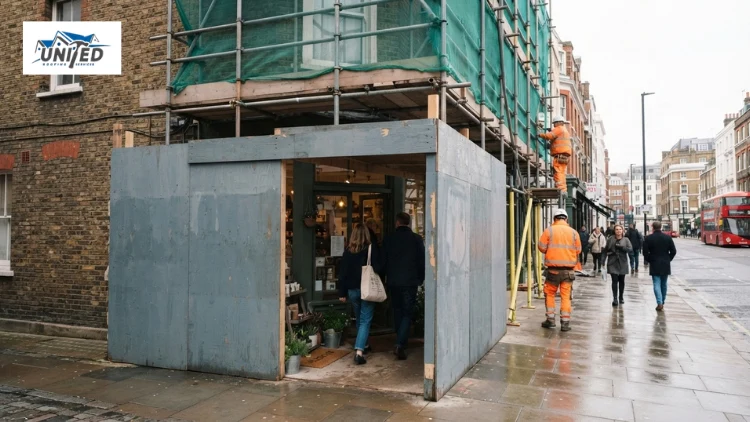
Most businesses can stay open with some planning:
- Phase the work, so one section is finished and watertight before the next one opens.
- Ask about out-of-hours or weekend work for the noisiest jobs, such as strip-out.
- Keep customer entrances and delivery routes clear and clearly marked.
- Cover stock and equipment below the work area, and move valuables away.
- Tell staff, neighbours and other tenants the dates in advance.
What Is the Best Time of Year for Roof Work?
Spring to early autumn gives the most dry days, but a good contractor works through cooler months too. You can lay felt and EPDM in cooler, dry weather. GRP needs dry conditions and mild temperatures, generally above about 5 degrees, so it is the system most affected by winter.
Rain delays are normal in the UK. Ask what temporary weatherproofing the contractor uses when a job is paused.
How Do You Choose a Commercial Roofing Contractor in London?
The right contractor matters as much as the right system. Membership of a trade body such as the NFRC is a good sign, because its roofing members are vetted and inspected. You can search the NFRC member directory by postcode.
What Should You Ask a Roofer Before a Commercial Roofing Project Starts?
- Are you fully insured, and can I see the certificates?
- What exactly is in the written specification, including the system, insulation and drainage falls?
- What happens if you find wet insulation or a rotten deck once the old roof is off?
- What guarantees come with the work, and who stands behind them?
- Who will be on site each day, and are they your own staff?
- Can I see similar jobs you have finished?
- Will you arrange Building Control sign-off?
Then ask every contractor to price the same specification. Otherwise, you are comparing different jobs, not different prices.
At United Roofing Services, we are a family-run team with 45 years of roofing experience across Richmond and nearby areas. Our roof installation services and flat roofing specialists can survey your building and talk you through the options. You can also see the areas we cover.
Before You Ask for a Quote
You will get a faster, sharper quote if you gather a few things first:
- Your lease and your landlord’s contact details
- The age of the building and any asbestos survey or register
- Dated photos of the roof and of any leak stains inside
- Invoices from past roof repairs
- Access details, such as building height, parking and delivery routes
- Any dates when the business cannot cope with disruption, such as peak trading weeks
Have those ready, and the survey conversation becomes much easier. When you are ready, talk to our team of roofing specialists.
Frequently Asked Questions
Does my commercial roof need replacing or just repairing?
Repair suits a single leak, split seam or failed flashing on an otherwise sound roof. Replace it if leaks keep returning, the membrane is cracking or blistering, or the roof is past its expected life. A survey with a moisture check will confirm which.
Can you fit a new commercial roof over the old one?
Sometimes. Overlaying only works if the existing roof is dry and sound, and the structure can take the extra weight. If the old roof is wet or rotten, you must remove it first.
Can I claim tax relief on a new commercial roof?
Like-for-like repairs are often a deductible business expense, while upgrades may count as capital expenditure. Ask your accountant before work starts. This is general information, not tax advice.
