
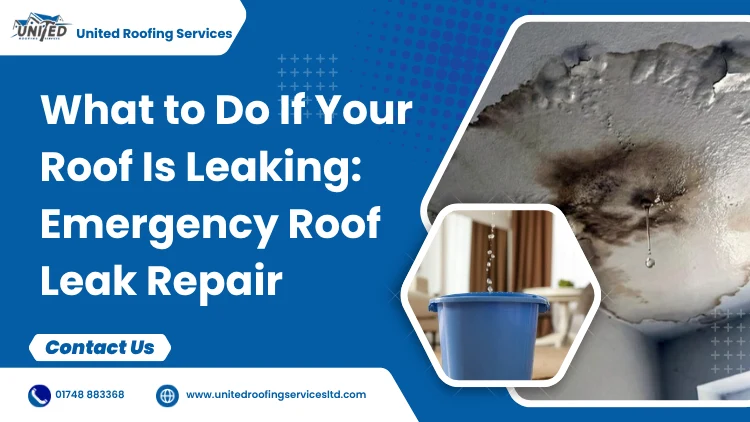
A damp patch spreading across the ceiling can turn an ordinary evening into a stressful one. Still, the good news is that a roof leak rarely means disaster if you act sensibly and quickly: contain the water, protect anything valuable nearby, take photos, and call a qualified roofer as soon as it’s safe to do so, while avoiding climbing onto a wet roof or assuming a small drip will sort itself out on its own.
The rest of this guide walks through exactly what to do, how to work out where the water is coming from, and when it’s time to bring in a professional.
Is Your Roof Leak an Emergency?
Not every drip needs a 2 am phone call, but some genuinely do. A leaking roof is usually an emergency if:
- Water is actively pouring or dripping through the ceiling, a light fitting, or a socket
- The ceiling is bulging, sagging, or looks like it could give way
- Tiles or sections of roof are visibly missing after a storm
- Water is anywhere near electrical wiring or the fuse box

If any of those apply, switch off power to the affected area if it’s safe, and get a roofer out straight away. If you’ve just noticed a faint stain that isn’t growing or dripping, it’s still worth investigating, but you have a bit more breathing room to arrange an inspection. United Roofing Services handles exactly these situations across Richmond and the surrounding area; more on that later in this guide.
What to Do if Your Roof is Leaking
The right response when your roof is leaking depends a little on exactly what you’re dealing with. Here’s how to handle the most common scenarios.
If Water Is Near a Light Fitting, Socket, or Switch
This is the one situation where speed genuinely matters more than anything else.
- Turn off power to that circuit, or the whole house if you’re unsure which circuit, at the consumer unit.
- Don’t touch the light switch or socket itself until the power is off
- Keep everyone, including pets, away from the area until an electrician or roofer confirms it’s safe. Electrical Safety First has clear guidance on what to do when water and electrics mix
- Once power is off, treat it as a normal leak and move on to containing the water
If the Ceiling Is Bulging or Sagging
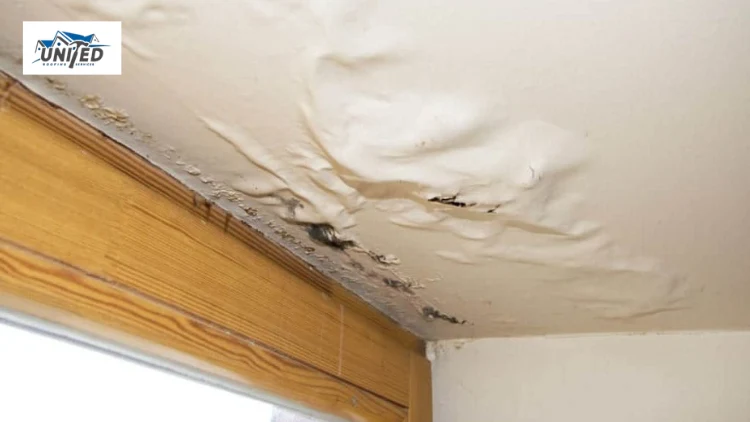
A bulge usually means water has pooled above the plasterboard rather than passing straight through.
- Never stand directly underneath it. A saturated ceiling can come down with very little warning
- If you can safely reach it with a pole or broom handle from outside the danger zone, a small controlled puncture in the centre of the bulge can release the trapped water into a bucket below, but only attempt this if you can do it without standing beneath the bulge
- If you’re at all unsure, leave it alone and wait for a professional. A ceiling repair is far cheaper than an injury
If You Discover the Leak at Night or While You’re Out
- Prioritise containment over investigation. It’s not worth inspecting a loft in the dark
- Place whatever containers you have immediately available; even mixing bowls or saucepans work in a pinch
- Move anything valuable nearby, then deal with a proper inspection in daylight unless the leak is severe
- If you’re out when a family member or housemate finds it, talk them through containment over the phone rather than waiting until you’re home
What to Keep on Hand for a Roof Leak
Having a few basics ready means you’re not scrambling when it happens:
- A couple of buckets or large containers
- Old towels or a roll of plastic sheeting
- A torch with working batteries
- Roofing tape or a small tarpaulin, useful for temporary external cover later
Once you’ve managed the immediate danger, take photographs of the damage from a few angles. These are useful both for the roofer diagnosing the problem and for your insurer if the cause turns out to be storm-related.
How to Find Where a Roof Leak Is Coming From
Finding the source of a dripping roof helps whoever comes to fix it, and it also helps you judge how serious the problem is.
Tracing the Leak from Inside
Water rarely enters directly above where it appears on your ceiling. It tends to travel along rafters, battens, or the underside of roofing felt before dripping down at the lowest or weakest point it can find, which might be a metre or more from the actual entry point.
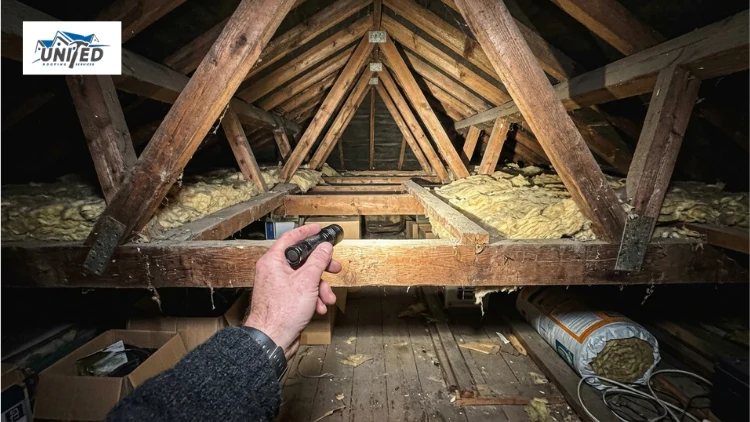
If you can safely access your loft:
- Take a torch and check timbers near the stain for damp patches, dark staining, or a musty smell
- Note whether the dampness worsens during or after rain, which helps confirm an active leak rather than old staining
- If you spot the damp timber, circle the area lightly with chalk and measure its distance from a fixed reference point, such as a chimney stack, roof vent, or the ridge line
That measurement is genuinely useful. It lets a roofer (or you, from outside) work backwards from a known landmark to find the likely entry point on the exterior, rather than guessing.
Signs to Spot from Ground Level
You don’t need to get onto the roof to gather useful clues. From the garden or an upstairs window, look for:
- Missing, cracked, or slipped tiles
- Sagging sections of roofline
- Overflowing or damaged gutters
- Debris caught around chimneys or valleys, which often signals where water has been pooling
How to Stop Roof Leaks in Heavy Rain
If you’re wondering how to stop my roof leaking in heavy rain, the honest answer is that you’re managing the situation, not curing it, until a roofer arrives.
Using a Tarpaulin Properly
- Only attempt this if it’s safe, daylight, and the wind has eased
- Drape the tarp so it extends well past the damaged area on all sides; water finds the smallest gap
- Weigh down every edge securely; sandbags or timber battens work better than loose bricks, which can slip
- Never tuck a tarp under tiles in a way that lifts them further; this can make the leak worse
Using Roofing Tape or Sealant
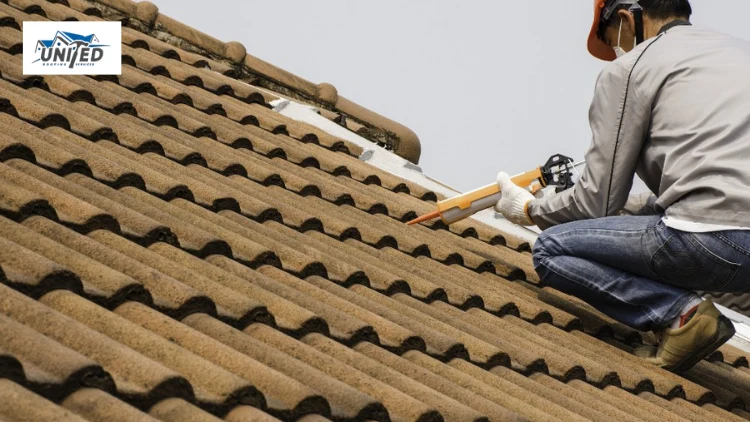
- Roofing tape works best on small, clean cracks in flashing or felt; press firmly and make sure the surface is dry first
- Roof sealant paint is genuinely useful for hairline cracks on accessible flat sections, but it’s not designed to bridge gaps or missing material
- Neither is a permanent fix; they’re stopgaps to protect your home until proper leaking roof repair can be carried out
Managing the Inside While It Rains
- Keep containers emptied regularly so they don’t overflow
- Increase ventilation in the room where possible to reduce damp buildup
- Recheck the area every hour or so during heavy, sustained rain, since roof leaks in heavy rain tend to worsen as the roof structure becomes increasingly saturated
If your roof is leaking right now, don’t wait for it to get worse. Get in touch for a fast, honest assessment and a free, no-obligation quote.
What NOT to Do When Your Roof Is Leaking
A few common instincts can quietly make things worse:
- Don’t climb onto the roof, especially in wet or windy conditions. It’s genuinely dangerous and can turn a leak into a fall injury. The HSE’s guidance on working at height explains why roof access is one of the most common causes of serious injury at home.
- Don’t seal the leak permanently from inside. This can trap moisture and redirect water somewhere less obvious, causing hidden damage.
- Don’t ignore a small, slow leak. Minor moisture can quietly ruin insulation, timber, and plaster over several months. Left unchecked, this kind of moisture buildup can lead to the issues covered in our damp proofing guide.
- Don’t use excessive force to check for a bulge, such as pressing on the ceiling with your hand. This can bring it down suddenly.
- Don’t assume one bucket is enough for a sustained leak. Check and empty containers regularly, especially overnight.
- Don’t wait for it to “dry out” on its own. Roof leaks very rarely resolve without repair.
Why Choose United Roofing Services for Emergency Roof Leak Repair in Richmond
United Roofing Services Ltd has spent over 25 years repairing roofs across Richmond and the wider Greater London area. We’re a Google-verified, fully insured, family-run team offering roof leak repair you can actually rely on, and every emergency callout gets treated with urgency, not a scheduled slot three weeks out. Whether the issue is a slipped tile after a storm, a failing flat roof membrane, or damaged flashing around a chimney, we diagnose the real cause before we touch anything, so the repair actually lasts.
Once you’ve contained the immediate damage, the next step is to get someone qualified to diagnose and fix the source. If you’re in Richmond or the surrounding area, United Roofing Services provides emergency roof repair services in Richmond, Twickenham, Kingston upon Thames, Esher, and Surbiton. Our team responds quickly to active leaks, and you can request a quote through our contact form.
Frequently Asked Questions
What usually causes a roof to start leaking?
The most common causes are slipped or cracked tiles, damaged flashing around chimneys and roof joins, blocked gutters forcing water back under the roofline, and roofing felt that’s worn out with age.
Why do older Richmond homes seem more prone to roof leaks?
Richmond has a lot of Victorian and 1930s housing stock, and the flashing and pointing around chimneys on these properties tends to loosen gradually with repeated wet-dry cycles, which is often why leaks appear a few days into a spell of bad weather rather than immediately.
Can a flat roof leak be repaired without replacing the whole roof?
In most cases, yes. A localised membrane split or a failed seal can usually be repaired on its own, though a full inspection is needed to confirm the damage hasn’t spread beneath the surface. For more detail, see our guide on what causes a flat roof leak and how to fix it.
Why do flat roofs leak more often than pitched roofs?
Flat roofs rely entirely on a membrane rather than overlapping tiles, so once that membrane is compromised, whether by splitting, ponding water, or age, there’s no secondary layer to catch the water before it gets in.
How can I prevent my roof from leaking in the future?
Regular gutter cleaning, periodic moss removal, and a roof inspection every couple of years catch small issues like loose tiles or early flashing wear before they turn into leaks.
Does moss on my roof actually cause leaks?
Yes, over time. Moss holds moisture directly against the tile surface, which speeds up wear and can work its way under tile edges, gradually creating gaps that water can get through.
